 Menu
Menu 


WHAT’S NEW
AT SCHWENK
Recap of the SCHWENK Concrete Seminars 2024
For many years, it has been a good tradition to kick off the new construction season with the SCHWENK Concrete Seminars. Unfortunately, in recent years the customer event could not always take place at the beginning of the year due to COVID. We were therefore all the more pleased to be able to hold the 2024 Concrete Seminars again in January as usual.
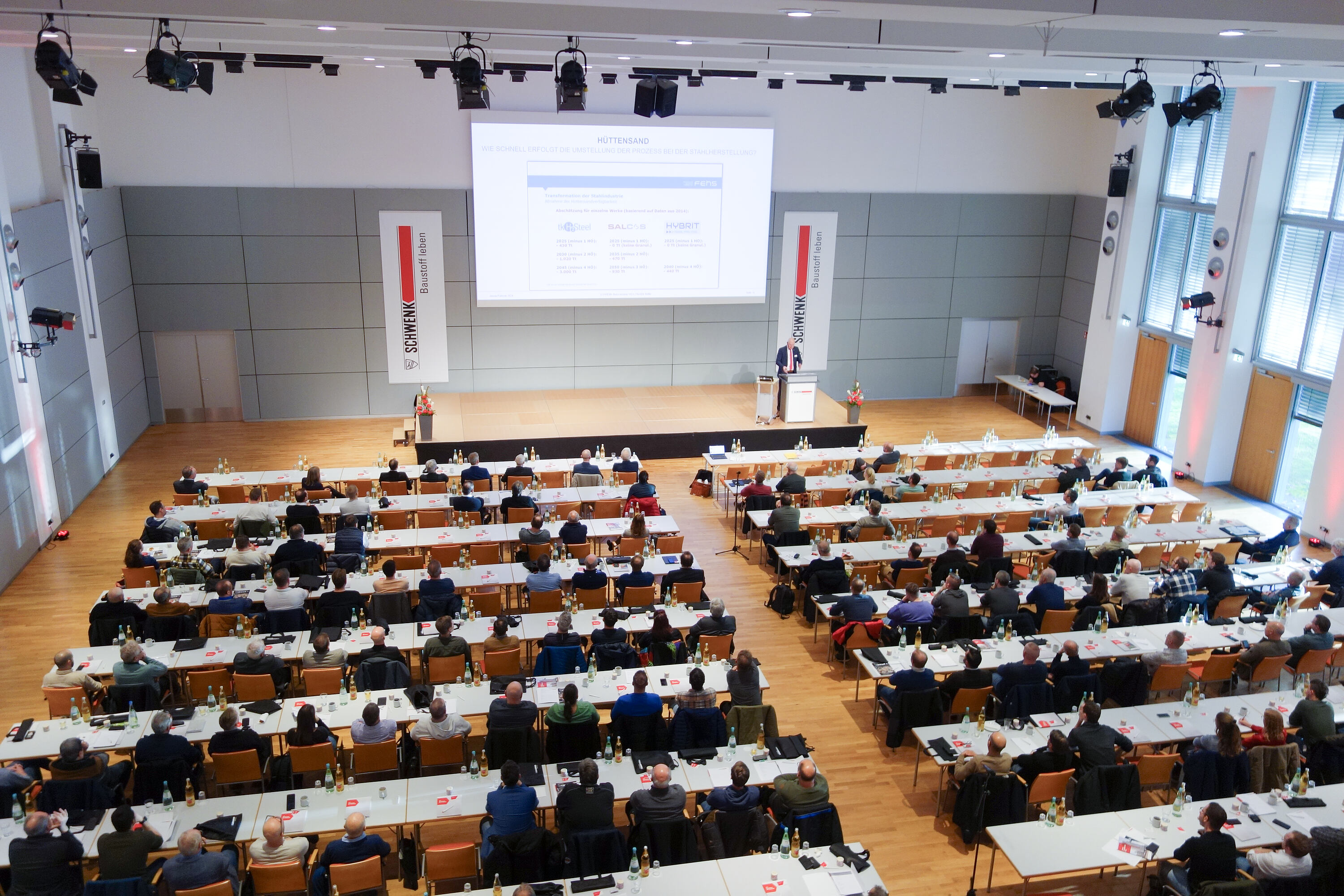
This year, a total of around 750 participants accepted the invitation to the events held by SCHWENK Zement GmbH & Co. KG at the three locations Schweinfurt, Leipzig, and Heidenheim.
The in-person events organized by SCHWENK Bauberatung are a fixed part of the calendar for customers, concrete manufacturers, construction companies, government representatives, architecture and engineering firms, as well as university representatives. They all took the opportunity of this industry gathering to learn about current topics related to the building materials cement and concrete, and to exchange ideas in person.
The central focus of this year’s events was on the topics of climate neutrality, clinker-reduced cements, and resource efficiency. These are the key challenges for cement and concrete manufacturers now and in the future.
Mr. Werner Rothenbacher, Head of SCHWENK Bauberatung, guided the participants through the seminar program and moderated the discussions as usual. He expressed his delight that once again so many participants had attended the Concrete Seminars.
The welcome address for participants as well as the first presentation, “Pathways to Climate Neutrality at SCHWENK,” was given by Dr. rer. nat. Hendrik Möller, Member of the Management Board of SCHWENK Zement GmbH & Co. KG. He explained that the biggest challenge at the moment is achieving climate neutrality within the given timeframe while simultaneously facing high investment needs. At SCHWENK, we are working in parallel on various solution strategies with which the statutory goal can be achieved. In addition, SCHWENK’s CO2 roadmap envisions a radical reduction of the clinker factor in cement as well as the capture and storage or utilization of the CO2 generated during the process.
To achieve this, a research and development facility of the CI4C consortium is being built in Mergelstetten to test the so-called “Pure Oxyfuel process.” Furthermore, at SCHWENK we are focusing on the market introduction of novel, innovative binders. Celitement will play an important role in this regard. However, finding an adequate replacement for the quantities of blast furnace slag and coal fly ash as supplementary cementitious materials that will be phased out in the coming years is also a particular challenge. To address this, a pilot plant is now being built at the Allmendingen site to fill this gap using clays and natural pozzolans. Dr. Möller concluded by emphasizing: “SCHWENK is prepared for the future!”
On the topic of “Clinker-Reduced Cements – Opportunities and Challenges,” construction consultants Dipl.-Ing. Heiko Zimmermann in Heidenheim and M.Sc. Christian Fratscher in Schweinfurt and Leipzig gave presentations. Two clinker-reduced cements are already established in ready-mixed concrete and thereby contribute to a lower CO2 footprint in concrete. The use of these cements is particularly advantageous for environmental certification according to CSC. The speakers anticipate that demand for certified climate-friendly concretes, especially in urban areas, will increase in the future. It is an advantage that all SCHWENK cement plants hold the CSC rating “Gold” and that ecological cement variants are available at every plant – in some cases even in bagged form. The transition to new cements in the precast concrete industry is a particular challenge, as early strength or stripping strength determines productivity in the plants. It has been shown with various customers that combining CEM I with a clinker-efficient cement (CEM II/B-M, CEM II/C-M, CEM III) can be one way to reduce the CO2 footprint while maintaining production cycles. Additionally, optimizing the mix design by adjusting the water-cement ratio or adding hardening accelerators can be a useful approach. SCHWENK Bauberatung is happy to provide advice on this matter.
Dipl.-Ing. Sven Mellwitz presented in Leipzig and Dipl.-Ing. Kai Fischer in Heidenheim and Schweinfurt on the new concrete standard DIN 1045 and BBQ. Participants received information on the new DIN 1045-1000:2023-08 “Fundamentals and Concrete Quality Classes (BBQ).” This divides the complexity of construction tasks into various concrete quality classes and defines the interfaces between planning, concrete production, and construction execution. The need for communication is to be strengthened, which is why the intensity increases from BBQ-N (normal requirements), BBQ-E (increased requirements), and BBQ-S (specially defined requirements). Planning and construction execution are also guided by this tiered system. The classification regarding concrete construction quality depends significantly on the use of the structure, the applicable exposure classes, strengths, and construction methods/curing. Example classifications gave participants a clear understanding of the system. In addition, new features and changes in DIN 1045-2:2023-08 “Concrete” were presented. Important guidelines from DAfStb have been integrated and the use of recycled aggregates has been made easier. The permitted addition quantities have been partially increased, and the use of RC crushed sand is possible under certain criteria. Furthermore, climate-friendly cements have been integrated into the standard and changes to the conformity assessment have been implemented. The full package of standards is expected to be introduced by the building authorities around the turn of the year 2024/2025.
In addition to climate change, improved resource efficiency in construction is also becoming increasingly important. Dipl.-Ing. Werner Rothenbacher, Head of Construction Consulting, provided information in his presentation “Resource Efficiency as a Building Block for Sustainable Construction” on the possibilities for saving mineral resources. This includes above all the use of recycled aggregates in R-concrete as well as their use as a raw material or supplementary cementitious material in cement production. Around one fifth of the total 1.2 billion tonnes of primary raw materials extracted in Germany is attributable to cement and concrete. Only a holistic approach leads to success; in addition to recycling, this also includes the reuse of building structures and entire components. The VDZ roadmap provides a good overview of the quantities that can be substituted in the future. Finally, the successful practical implementation of the circular economy in the project “Resource-Saving Renovation of the Mercedes-Benz Arena” was presented in detail.
With well-founded data and facts on the topic of “Concrete 4.0 – a Contribution to Climate-Optimized Concrete,” scientists from the Institute of Building Materials at Leibniz University Hannover, Dr.-Ing. Max Coenen in Schweinfurt and Prof. Dr.-Ing. Michael Haist in Leipzig and Heidenheim, demonstrated how artificial intelligence can be used for quality assurance in concrete production. By using digital images such as slump flow tests and sensor data, it is possible to make predictions about expected material properties in a trained AI environment. The speakers presented the fundamentals and promising examples from both laboratory and practical applications.
During the subsequent lunch, all participants had the opportunity to refresh themselves and discuss the technical presentations with each other or with the speakers.
The afternoon at the Concrete Seminars is dedicated to the well-known speakers and experts who present interesting topics beyond the building materials cement and concrete.
In Schweinfurt, internet crime expert Cem Karakaya from Munich entertained the audience with his anecdotes and expertise on the topic “What do James Bond and Cybercriminals have in common?” In a humorous way, he demonstrated how each individual handles personal data on the internet and social media, and how criminals can exploit this knowledge.
Business psychologist Dr. Carl Naughton from Wiesbaden demonstrated in his presentation in Leipzig how “courage for the future can serve as food for thought.” The focus of his talk was on the human capacity for mental adaptability to change, and he provided valuable insights into helpful coping strategies in both professional and personal life.
Back in 2022, neuroscientist Prof. Dr. med. Volker Busch from Regensburg already fascinated participants in Leipzig with his presentation on “Brain Under Pressure.” This year, the presentation was also very well received in Heidenheim. A look inside the brain reveals ways to deal intelligently with information overload, multitasking, and the digital everyday life. He provided tips and tricks on how each individual can escape the spiral.
We are already looking forward to next year’s seminars, which are expected to take place on the following dates and at the following locations:
- Thursday, January 23, 2025 in Heidenheim
- Tuesday, January 28, 2025 in Schweinfurt
- Thursday, January 30, 2025 in Leipzig