 Menu
Menu


AT SCHWENK
Research and development project “catch4climate”: Another milestone reached in the construction of the CO2 capture facility
You are currently viewing a placeholder content from YouTube. To access the actual content, click the button below. Please note that doing so will share data with third-party providers.
© Goetsch Media
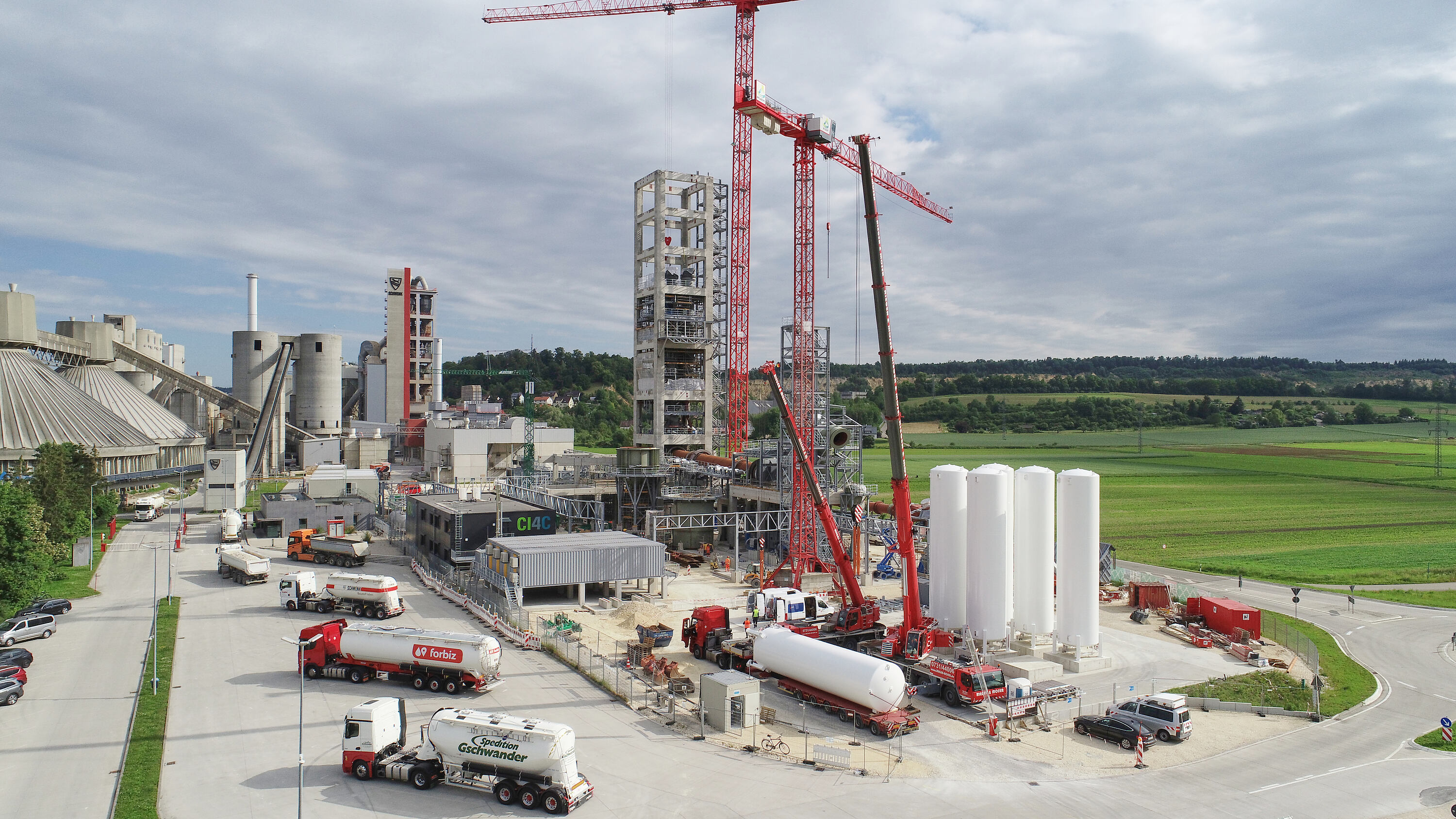
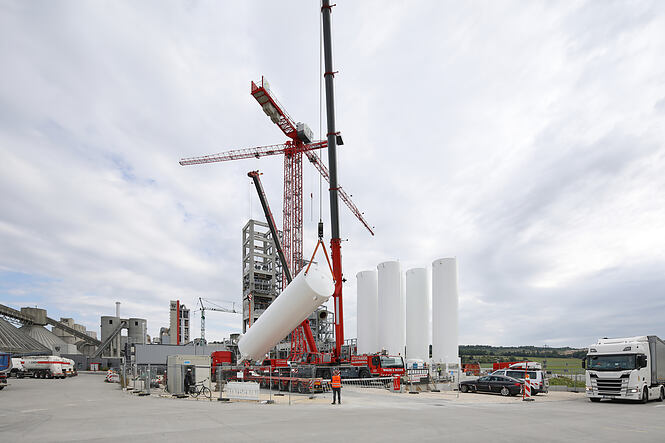
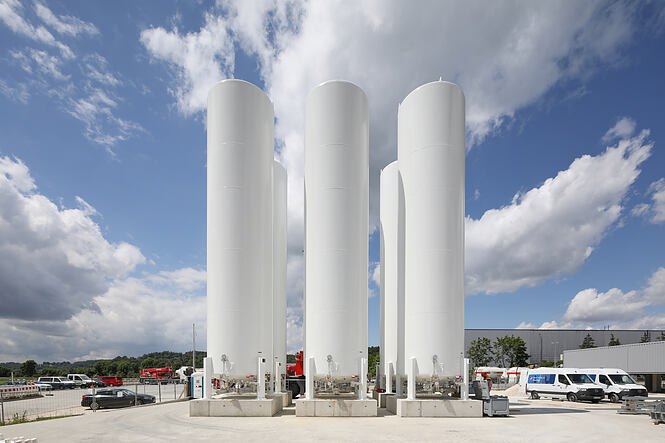
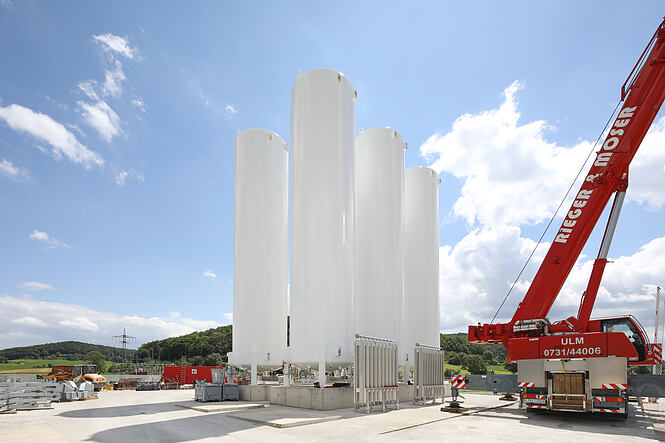
- In mid-June, the six oxygen tanks for the oxyfuel plant were installed at the construction site of the CO2 capture project “catch4climate”.
- The commissioning of the oxyfuel kiln plant, for the construction of which over 120 million euros are being invested, is expected to take place in the first quarter of 2025.
With the delivery and installation of six oxygen tanks, another important milestone was reached in mid-June in the catch4climate project of the research company CI4C, a consortium of four European cement manufacturers: Buzzi SpA – Dyckerhoff GmbH, Heidelberg Materials AG, SCHWENK Zement GmbH und Co. KG and Vicat S.A.
Using two mobile cranes in a tandem lift, the tanks, each weighing around 26 tonnes, were lifted onto the designated foundations. The vacuum-insulated tanks provide a total storage capacity of approximately 360 cubic metres of liquid oxygen, which is required in the new oxyfuel plant for combustion in the rotary kiln. The engineering as well as the delivery and installation of the tank facility was carried out by Westfalen AG, which has been involved in the “catch4climate” project from the very beginning and, in addition to the oxygen supply, also takes on the responsibility of conducting training measures for the research company CI4C.
The future delivery of oxygen will be by truck as a cryogenic liquid (LOX = Liquified Oxygen). Cryogenic liquids are heavily cooled gases with a boiling point near -100°C or below. In order to deliver the required quantities of oxygen to the CI4C site in Mergelstetten with the lowest possible truck traffic, Westfalen AG operates an air separation unit in Laichingen. There, the main components of ambient air, nitrogen and oxygen, are separated by a technical process and cooled under pressure to approximately -187 degrees Celsius and liquefied.
The commissioning of the oxyfuel kiln plant is expected to take place in the first quarter of 2025. Following commissioning, a research and development period of approximately three years is planned – provided the progress of results requires it – in order to generate the research and development findings.
© Conné van d´Grachten
Info box
CI4C
The four European cement manufacturers Buzzi SpA – Dyckerhoff GmbH, Heidelberg Materials AG, SCHWENK Zement GmbH und Co. KG and Vicat S.A. joined forces in 2019 to form the research company CI4C GmbH & Co. KG, with the aim of jointly realising the CO2 capture project “catch4climate” on the premises of SCHWENK’s cement plant in Mergelstetten. The facility, for the construction of which over 120 million euros are being invested, will for the first time apply the so-called pure oxyfuel process for CO2 capture. A dedicated rotary kiln line with a clinker production capacity of 450 tonnes per day will be built for this purpose, serving exclusively for research and development.
The Pure Oxyfuel Process
The pure oxyfuel process used in Mergelstetten (from oxy for oxygen and fuel) is a clinker firing process in which pure oxygen, rather than air, is introduced into the kiln in order to ensure heat generation while excluding atmospheric nitrogen during combustion. In this way, the proportion of CO2 in the flue gas is increased to approximately 90 percent, thereby significantly expanding the CO2 capture potential. The aim is to capture 100 percent of the CO2 emissions of a cement plant in a cost-efficient manner. The project is also intended to create the conditions for the large-scale deployment of CO2 capture technologies in the cement industry. The capture enables subsequent utilisation or storage of the CO2 (CCU, CCS).
In many industrial sectors – such as the production of fertilisers, fuels for long-haul flights or plastic-based hygienic medical products – carbon is urgently needed. Until now, this carbon has been obtained almost exclusively from fossil fuels. A further option is offered by the capture and utilisation of the CO2 produced in the cement industry as a carbon carrier.