 Menu
Menu


AT SCHWENK
Machine polishing of outdoor concrete floors with air-entrained concrete – a field report
SCHWENK Beton Alb-Donau GmbH & Co. KG built and commissioned a new high-performance ready-mixed concrete plant in the Ulm-Donautal industrial area in 2016/2017. The centerpiece is the tower facility with a height of 30 m and 2 loading lanes, as well as a separate administration building.
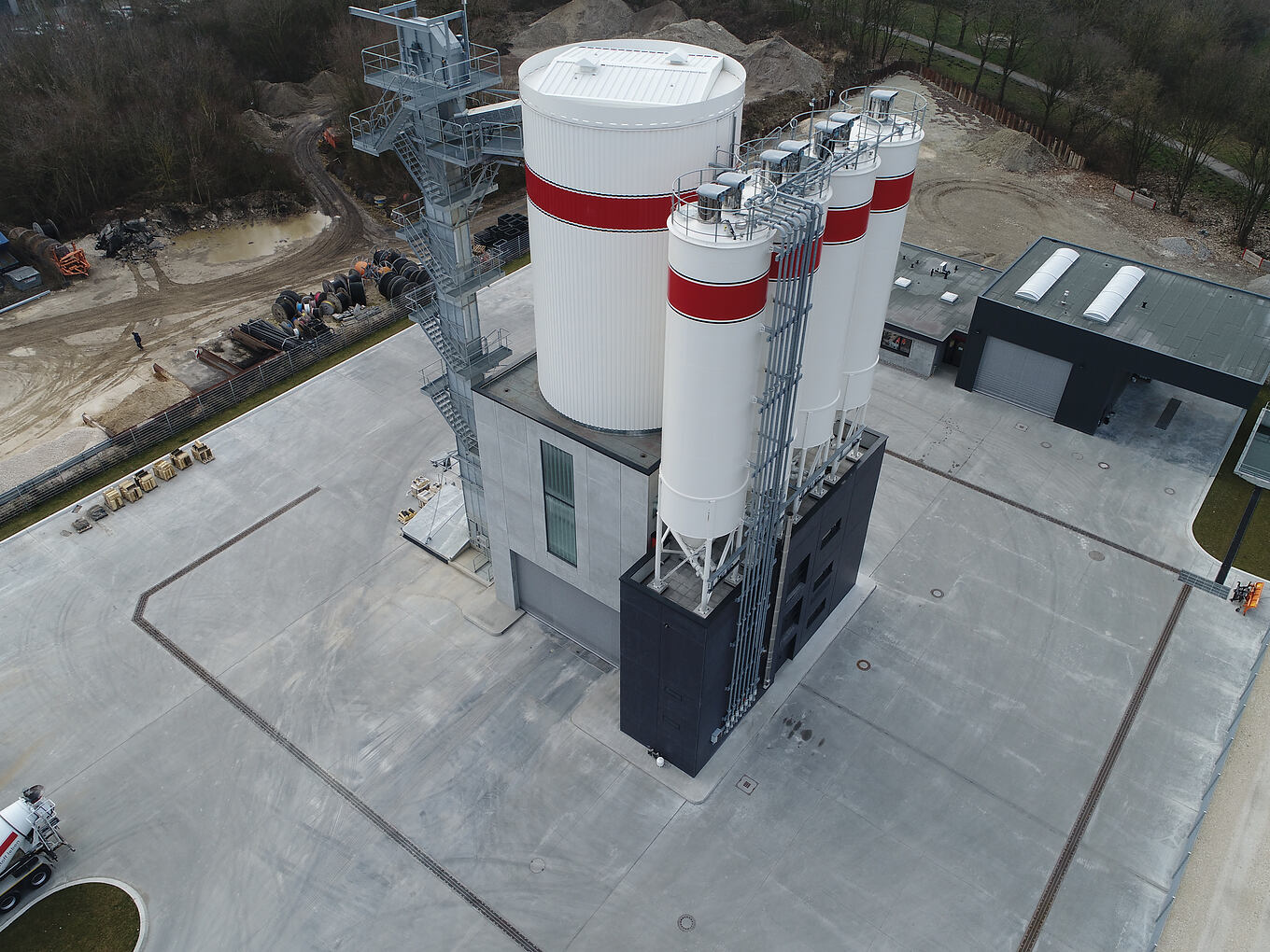
Image 1: Mixing plant with open areas and administration building in the background in 2017 (aerial photo SCHWENK)
With such a facility, the open areas take on particular importance. The project involved constructing 3,000 m² of open areas in concrete construction. The constant truck traffic with deliveries of raw materials such as cement, sand and gravel, additives and admixtures, as well as the concrete mixer trucks with a total weight of up to 40 tonnes, represent extreme dynamic loads on the open areas.
Additionally, the application of de-icing agents in combination with frost must be taken into account. Here, the use of air-entraining admixtures is a prerequisite. At the time, in consultation with the client, planner, and the executing company, the decision was made to install the concrete manually rather than with a paver, due to the many changes in gradient and built-in elements such as drainage channels and manholes.
The proposal by the construction company and SCHWENK Bauberatung to lightly smooth the air-entrained concrete with a power trowel with disc attachment led to some discussion. It is known from technical literature that intensive smoothing of air-entrained concretes destroys the air pores and therefore the frost/de-icing salt resistance can no longer be guaranteed. However, other projects have shown that with a single light smoothing pass using a power trowel with disc attachment, the air pores at the surface are not destroyed and the frost/de-icing salt resistance is maintained.
As a mix design proposal, a concrete with the requirements C30/37, XC4, XD3, XF4, XM2, WA, consistency F3 was selected with the following composition:
| Cement CEM II/A-LL 42.5 R – SCHWENK Allmendingen | 360 kg/m³ |
| W/C ratio | 0.45 |
| Superplasticizer BASF SKY | 681 0.70% by mass of cement |
| Air-entraining agent BASF | 0.18% by mass of cement |
| Sand 0/2 mm | 635 kg/m³ |
| Gravel 2/8 mm | 461 kg/m³ |
| Gravel 8/16 mm | 673 kg/m³ |
| Air void content | 5.5% |
| Compressive strength after 28 days | 46 N/mm² |
| Scaling CDF test | 198 g/m² |
Table 1: Mix design and initial test results
There was already experience with this mix design for bus lanes or similarly loaded open areas. The use of crushed stone or reference to the ZTV/TL-Beton was omitted for reasons of simplification. According to the “Guidelines for Planning, Design and Construction of Traffic Areas in Concrete (M VaB) – Part 1: Roundabouts, Bus Traffic Areas and Rest Areas” published by the Research Association for Roads and Transportation (FGSV) in 2013, this is also possible in consultation with the planner.
After placing the fresh concrete in consistency F3, an intermediate curing compound was immediately applied to prevent premature drying of the surface. After 2-3 hours, the smoothing process could already begin.
The installation was closely monitored by the SCHWENK Technology Center. Test areas were even created from which core samples were extracted and subsequently subjected to a CDF test. It was demonstrated that the surfaces processed with the power trowel also exhibit good frost/de-icing salt resistance.

Image 2: Smoothing process with power trowel and disc attachment
The light smoothing with the power trowel was followed by the application of a broom finish to ensure slip resistance. The concrete surfaces were then cured by placing sheeting on top. The joint cutting was carried out one day after installation. A few weeks after the construction of the concrete surfaces, the ready-mixed concrete plant was commissioned.
Condition after 6 years of use:
The ready-mixed concrete plant has now been in operation for 6 years and is well utilized. Since there were concerns at the beginning of the project about the execution of the concrete surfaces with the smoothing process, it was interesting to see whether these concerns were justified.
Frost/de-icing salt damage to concrete surfaces typically occurs within the first few years of use. Had the air pores in the near-surface layer been destroyed by the smoothing process, damage and scaling would have already appeared after the first winters.
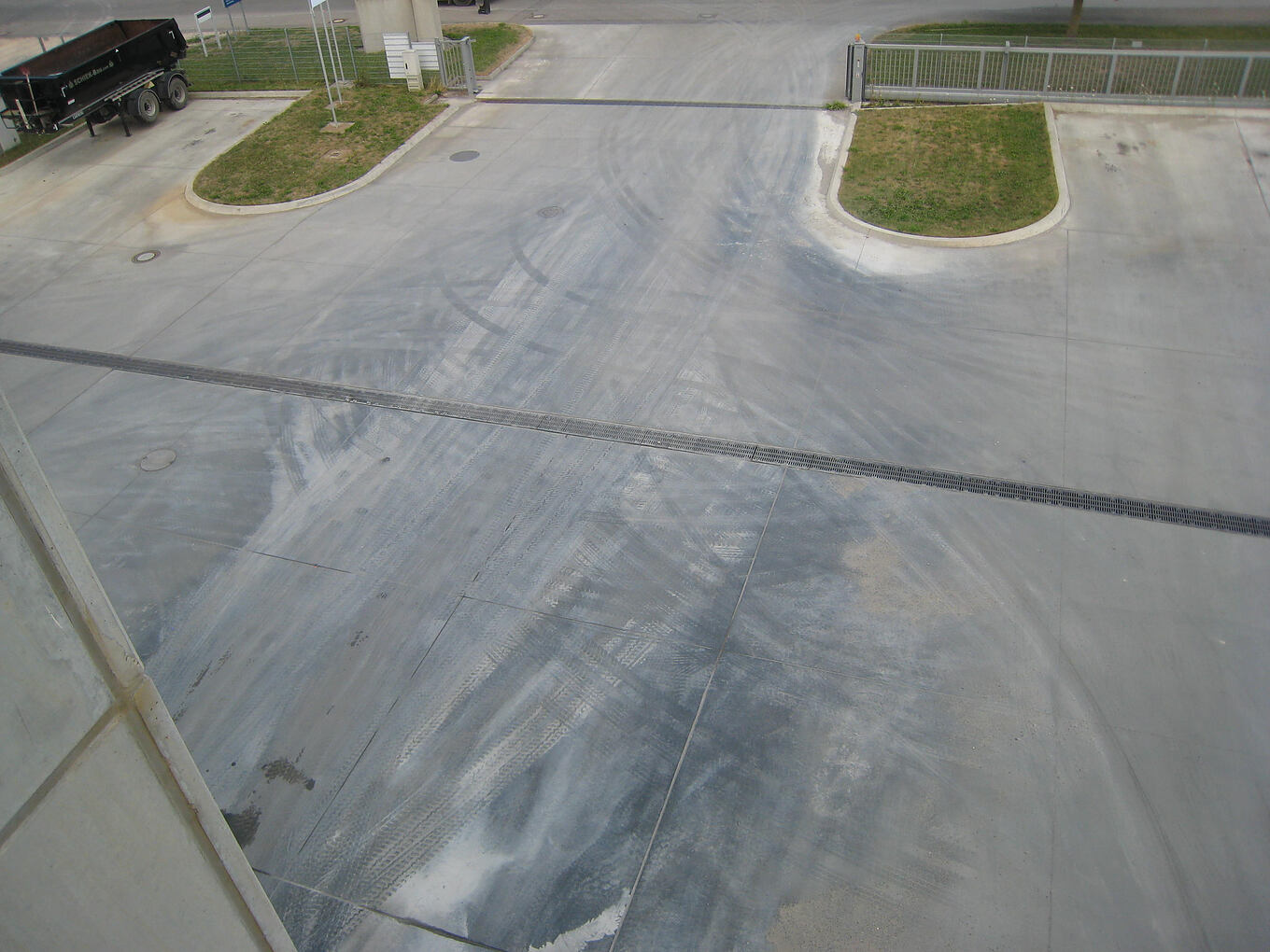
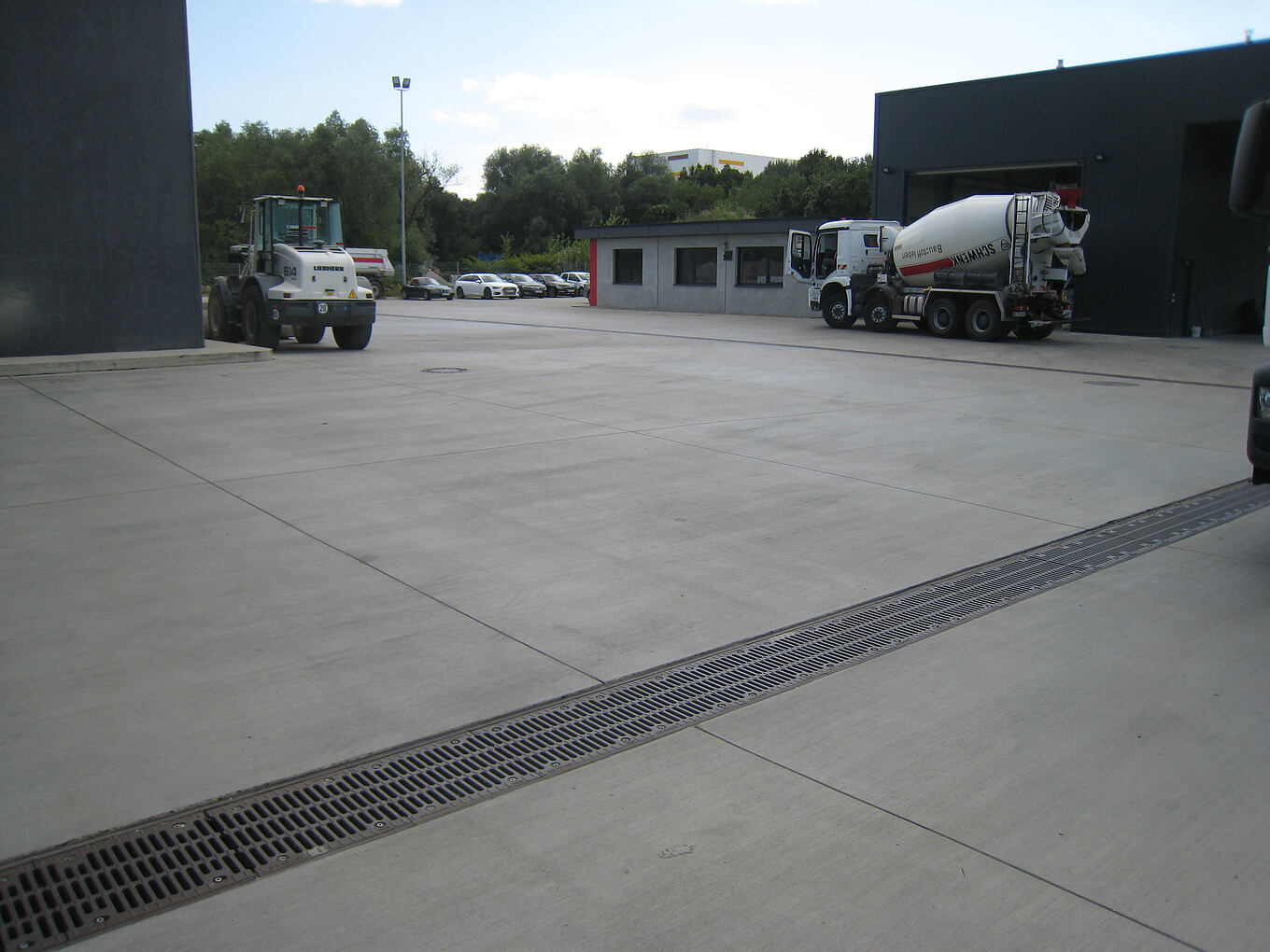
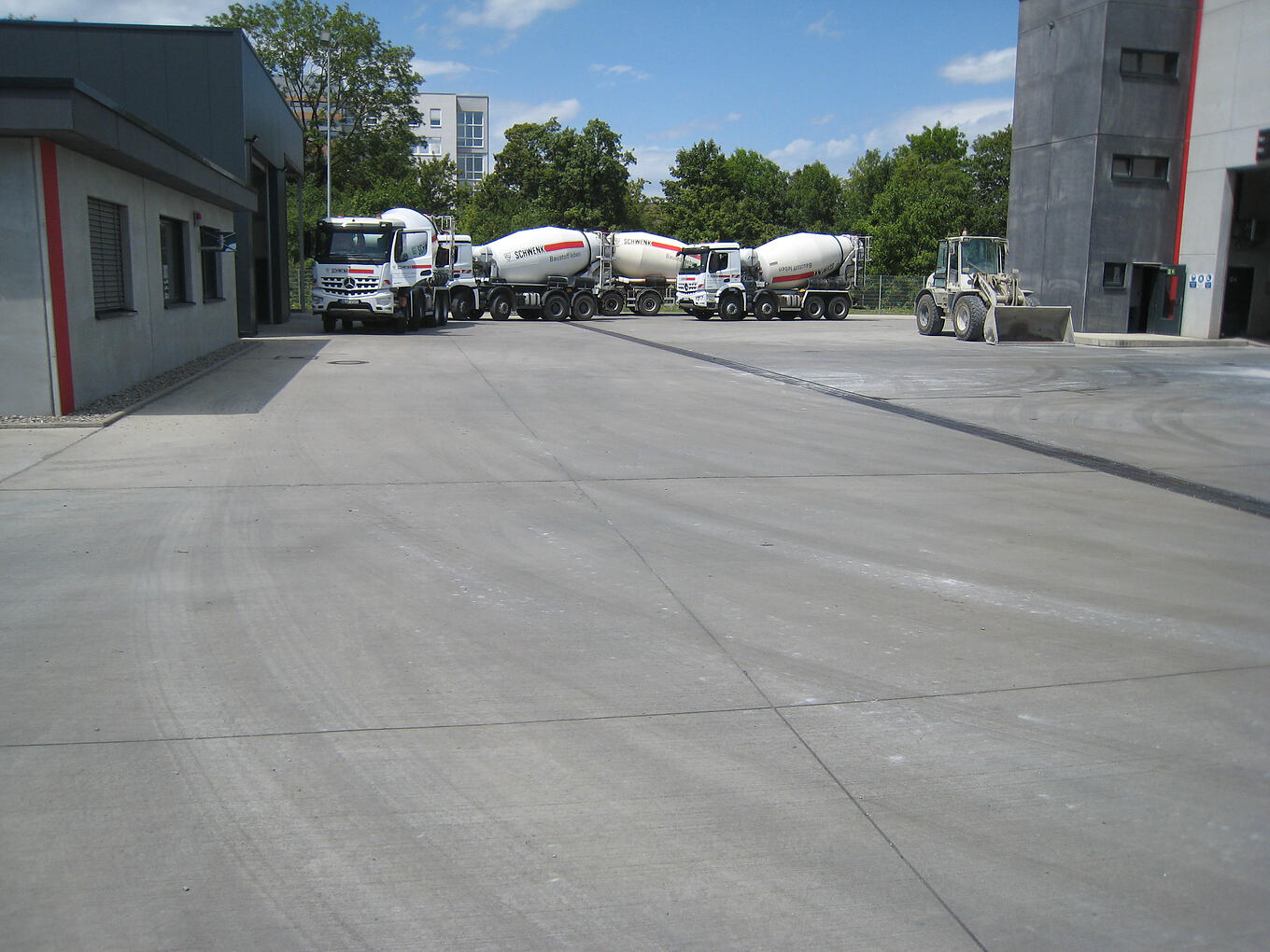
Image 3: Concrete surface in the entrance area with typical signs of use
Image 4: No spalling whatsoever at channels and joints
Image 5: Despite high loading, still good surface quality
This is not the case. After 6 years of intensive use, it can be confirmed that the concrete surfaces are in a very good condition given the level of stress they are subjected to, showing only the usual signs of use. There is no scaling or other damage indicating a disturbed air void system in the surface. Even the joints are still in very good condition. The project thus confirmed that light smoothing of air-entrained concretes with power trowels is possible.
In parallel, in 2017, 4,000 m² of open areas around the new DeCONOx plant for the reduction of nitrogen oxides were also constructed at the Allmendingen cement plant using the same construction method. Here too, after 6 years of intensive use, no frost damage whatsoever was found.
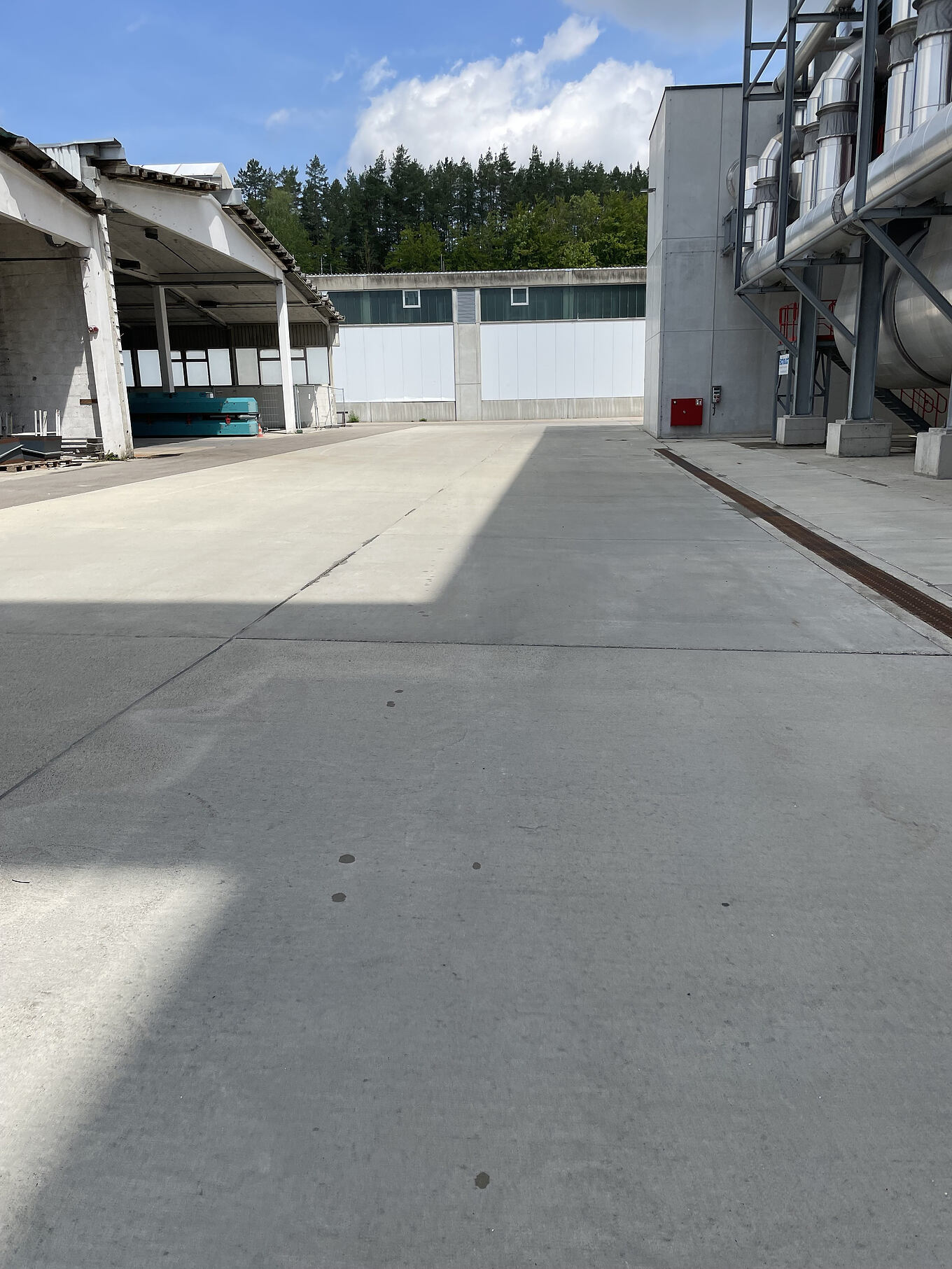
Image 6: Concrete surfaces at the DeCONOx plant in Allmendingen
It can therefore be established that the construction method for open areas using air-entrained concrete and light smoothing with a power trowel with disc attachment can certainly work. However, it must be noted that the smoothing process is only carried out lightly and that the surfaces are also properly cured. The procedure must be agreed upon in advance with all parties involved, and the installation and surface treatment must be closely monitored.