 Menu
Menu


AT SCHWENK
Simply explained
What is concrete?
Discover the world of concrete with SCHWENK: From ancient origins to modern architecture, learn everything about the composition, types, and significance of concrete.
Introduction: The significance of concrete in the past and today
As the backbone of modern architecture, concrete is far more than just a ubiquitous building material – it is a symbol of progress and permanence. With an impressive annual production of over 52 million cubic meters in Germany alone, concrete stands at the top of the most widely used materials worldwide. This immense figure reflects its central role in the construction and shaping of our urban landscapes.
Concrete’s journey through time is fascinating. It begins in ancient civilizations, where early forms of lime mortars were used, and extends to the present day, where concrete shapes the skyline of every major city. From the Roman engineers who created groundbreaking structures such as the Pantheon using a concrete-like substance called “Opus caementicium,” concrete has established itself to this day as a testament to human creativity and engineering excellence.
Today, concrete stands not only for strength and durability, but also for adaptability and innovation. It is a building material that outlasts generations and creates values that go far beyond mere functionality. Concrete, in its simple elegance and robust nature, tells the story of human progress and remains an indispensable element of our built environment.
Composition and production of concrete
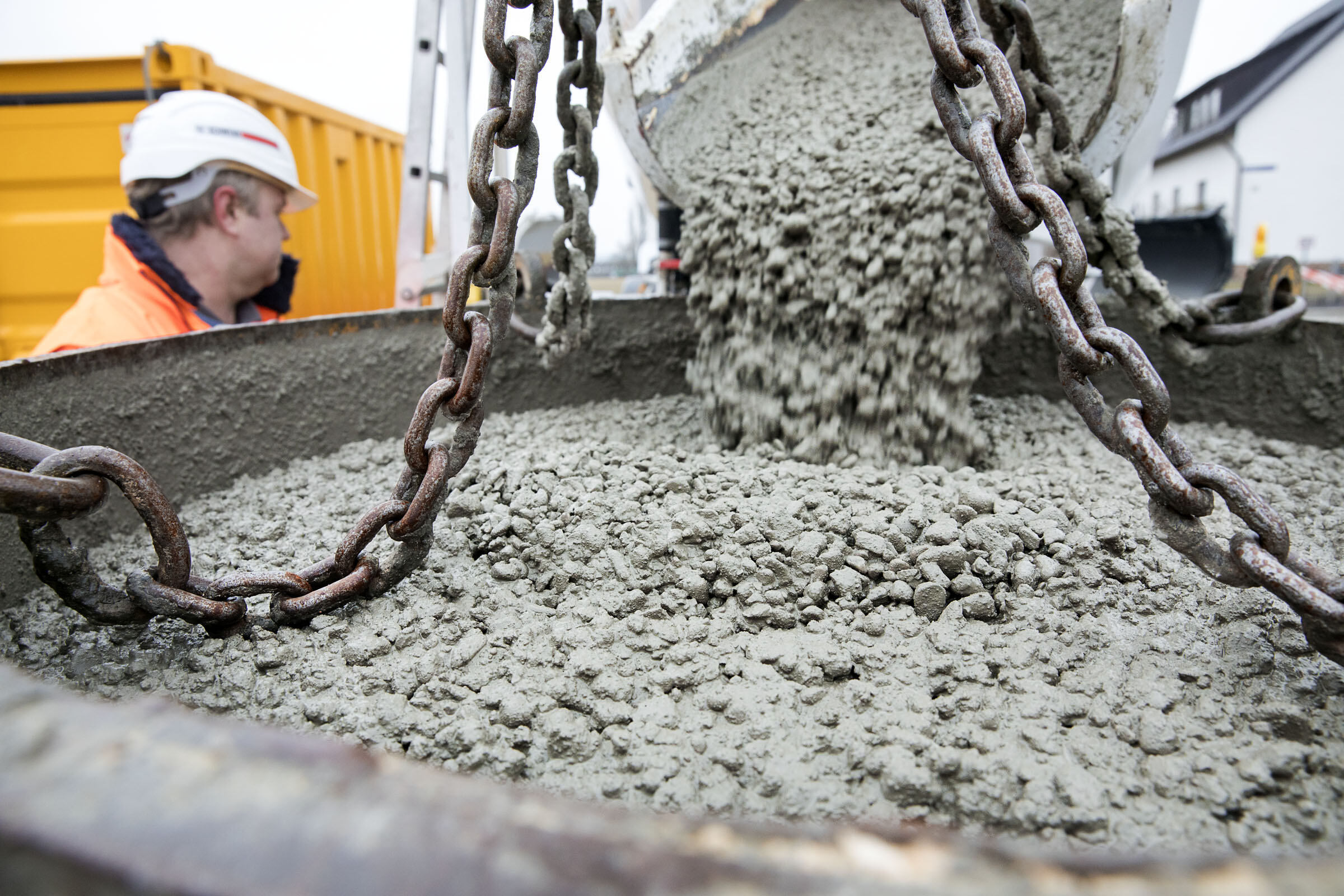
The composition of concrete is a fascinating symbiosis of simplicity and science, based on three main components: cement, aggregates, and water. Aggregates, such as sand, gravel, or crushed natural stone, make up approximately 70 to 80 percent of the concrete volume. They vary in their type and thereby significantly influence the physical properties of the concrete. The heart of concrete, cement, acts as a binding agent that, through its hydraulic properties, guarantees the strength and durability of the concrete. Various types of cement, such as Portland cement or pozzolanic cement, offer different properties for specific applications. The cement standard DIN EN 197 regulates over 20 types of cement. Water, as the third essential component, initiates the chemical reaction of the hardening process (hydration) and, together with the cement, forms the cement paste. Hydration is a chemical-mineralogical process that takes place both underwater and in air. The precise selection and mixing of these components, often supplemented by admixtures and additives, enables the production of concrete in various qualities and for diverse application areas. The local raw material sources of the concrete plants also contribute to the unique characteristics and coloring of the final product. The production process, which is carried out under strict standards such as DIN 1045-2, is a further decisive factor that determines the quality and performance of the concrete. In this way, what appears to be a simple combination of ingredients produces a building material that, through its versatility and durability, forms the foundation of our modern structures.
Various properties and types of concrete
Concrete varies in form and function, with normal concrete, consisting of cement, aggregates, and water, being the most widely used. An innovative development is fiber-reinforced concrete, which gains additional strength and flexibility through the addition of plastic, glass, or steel fibers. Textile-reinforced concrete, another novel form, incorporates carbon fibers or alkali-resistant glass fabric, giving it special structural properties.
Concrete types can be differentiated according to various criteria. These include compressive strength, dry bulk density – categorized into normal-weight, heavyweight, and lightweight concrete – and consistency, which can range from stiff to highly fluid. Furthermore, the intended use is a determining factor, such as in the case of ready-mixed concrete, concrete for precast applications, underwater concrete, or water-impermeable concrete. The type of aggregate, ranging from crushed stone and gravel to sand, as well as the method of compaction, such as rammed, vibrated, or sprayed concrete, are also important distinguishing characteristics.
In addition to these types, concrete is characterized by a wide range of properties, including compressive strength, workability, water impermeability, thermal insulation, frost resistance, dimensional and volume stability, as well as sound insulation. These properties vary depending on the type and composition of the concrete, making it suitable for a very broad spectrum of applications in modern architecture.
Sustainable Concrete:
By using recycled aggregates from demolition material, regional resources of sand, gravel, and natural stone can be conserved. Such concretes are therefore also called resource-efficient concretes, or “R-concretes” for short. In addition, the CO2 footprint of concrete can be significantly reduced through the use of clinker-efficient cements. This can make an important contribution to reducing greenhouse gas emissions in construction while maintaining comparable performance. Concrete will be indispensable in the future, but everything is being done to make concrete climate-friendly and sustainable.