 Menu
Menu


AT SCHWENK
Research project “catch4climate”: Major progress in the construction of the CO2 capture facility in Mergelstetten
You are currently viewing a placeholder content from YouTube. To access the actual content, click the button below. Please note that doing so will share data with third-party providers.
© Goetsch Media
- At the construction site of the CO2 capture project “catch4climate“, the kiln was installed in March.
- The facility, for the construction and operation of which over 120 million euros are being invested, will for the first time apply the so-called pure oxyfuel process for CO2 capture.
- The commissioning of the oxyfuel kiln plant is expected to take place in the first quarter of 2025.
The four European cement manufacturers Buzzi SpA – Dyckerhoff GmbH, Heidelberg Materials AG, SCHWENK Zement GmbH und Co. KG and Vicat S.A. joined forces in 2019 to form the research company CI4C GmbH & Co. KG, with the aim of jointly realising the CO2 capture project “catch4climate” on the premises of SCHWENK’s cement plant in Mergelstetten. The facility, for the construction and operation of which over 120 million euros are being invested, will for the first time apply the so-called pure oxyfuel process for CO2 capture. A dedicated rotary kiln line with a clinker production capacity of 450 tonnes per day will be built for this purpose, serving exclusively for research and development.
The four European cement manufacturers Buzzi SpA – Dyckerhoff GmbH, Heidelberg Materials AG, SCHWENK Zement GmbH und Co. KG and Vicat S.A. joined forces in 2019 to form the research company CI4C GmbH & Co. KG, with the aim of jointly realising the CO2 capture project “catch4climate” on the premises of SCHWENK’s cement plant in Mergelstetten. The facility, for the construction and operation of which over 120 million euros are being invested, will for the first time apply the so-called pure oxyfuel process for CO2 capture. A dedicated rotary kiln line with a clinker production capacity of 450 tonnes per day will be built for this purpose, serving exclusively for research and development.
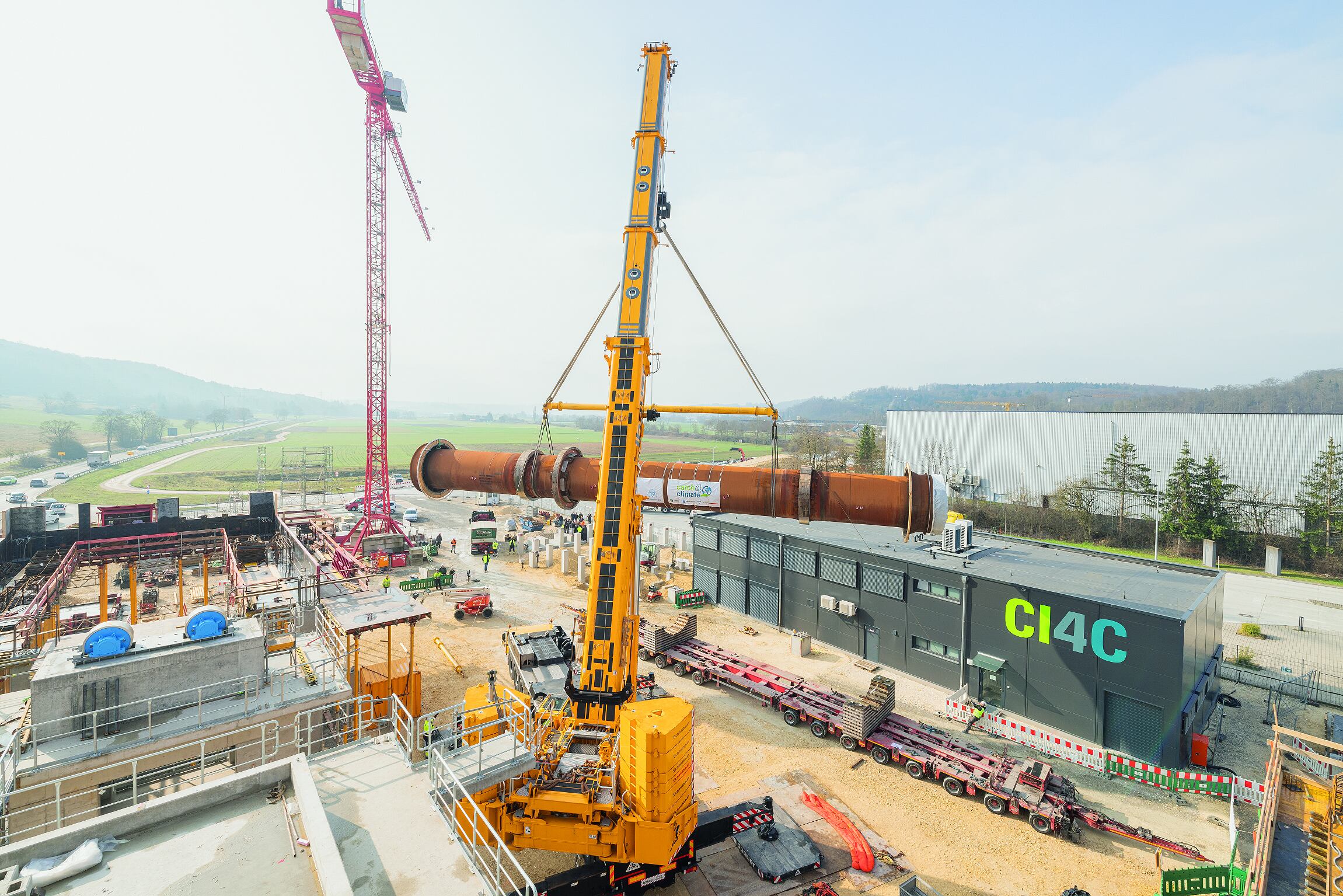
The rotary kiln was transported in December 2023 by inland waterway from Hamm-Uentrop to the port of Heilbronn, where it was initially stored temporarily until the on-site construction work for the kiln installation had been completed. The remaining journey to Mergelstetten was then carried out by heavy goods vehicle during the night hours, in order to cause as little disruption to traffic as possible. Due to its compact dimensions, the kiln is the first that Polysius has transported complete with tyre and ring gear in a single piece and placed onto the kiln foundations in a single lift. To achieve this, all installation sequences on the construction site were planned in advance in such detail – in addition to developing the transport concepts – that the rotary kiln could be set in place in a single lift without delay. A 700-tonne crane was used to lift the kiln into position on 7 March 2024.
The commissioning of the oxyfuel kiln plant is expected to take place in the first quarter of 2025. Following commissioning, a research and development period of approximately three years is planned – provided the progress of results requires it – in order to generate the research and development findings.
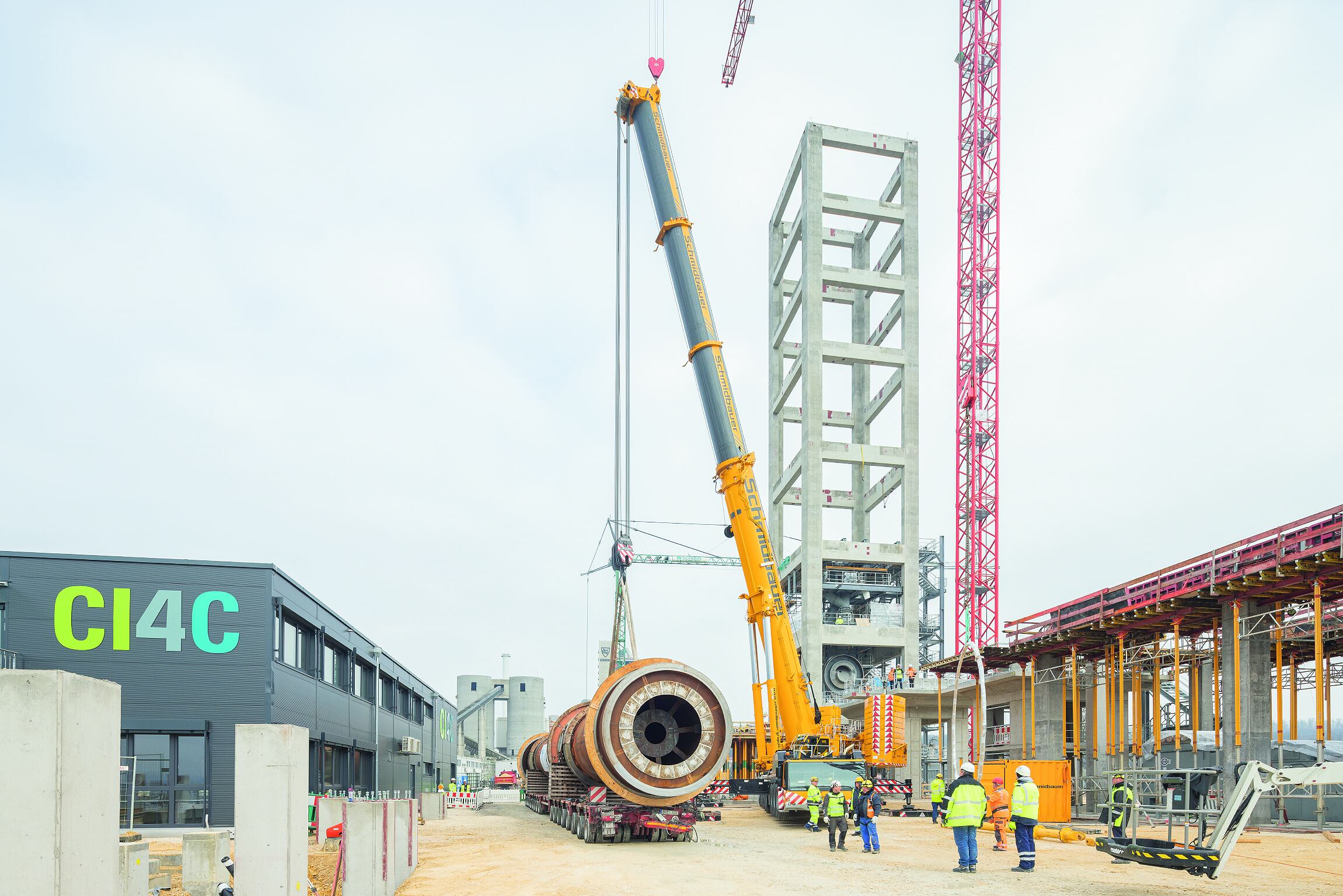
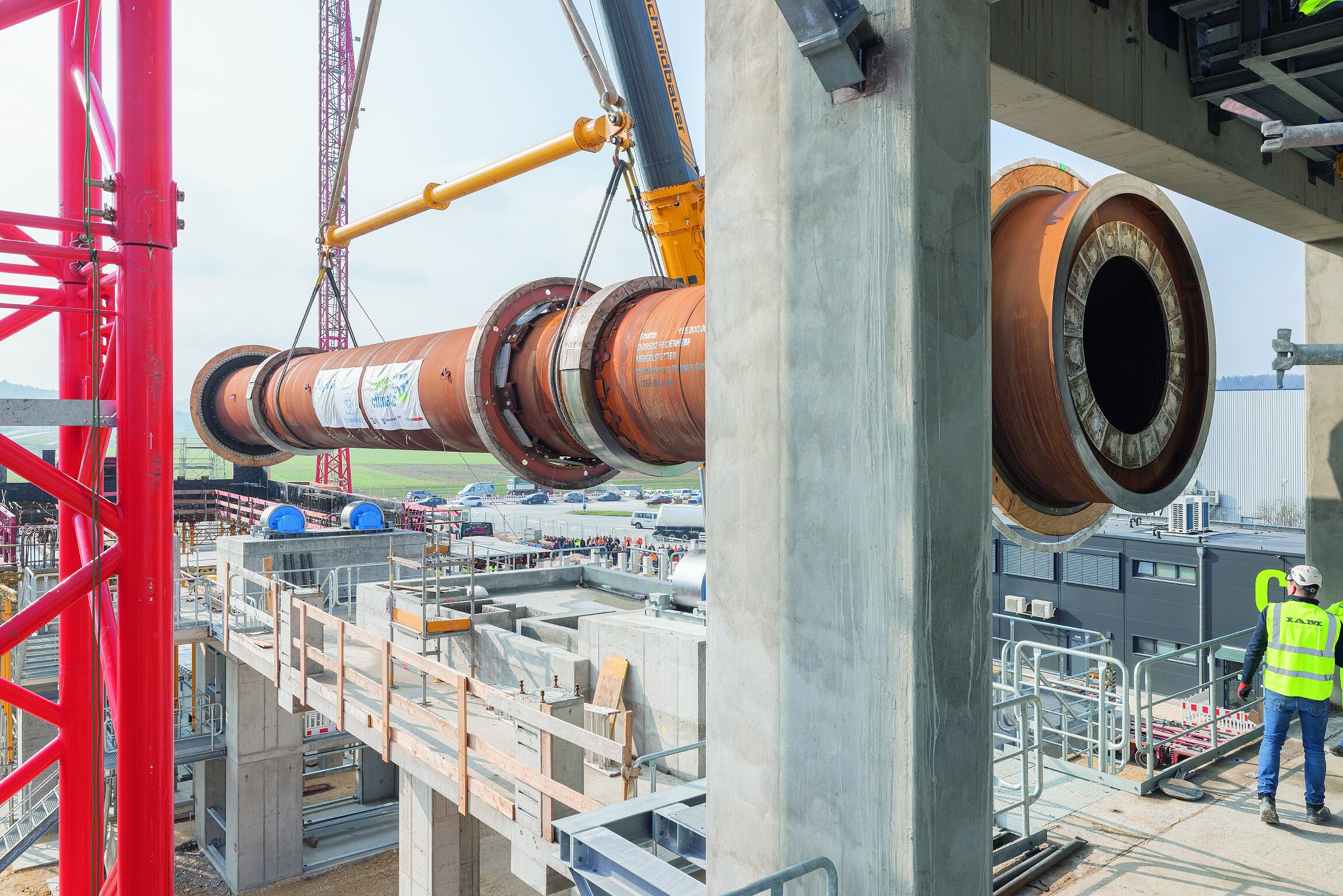
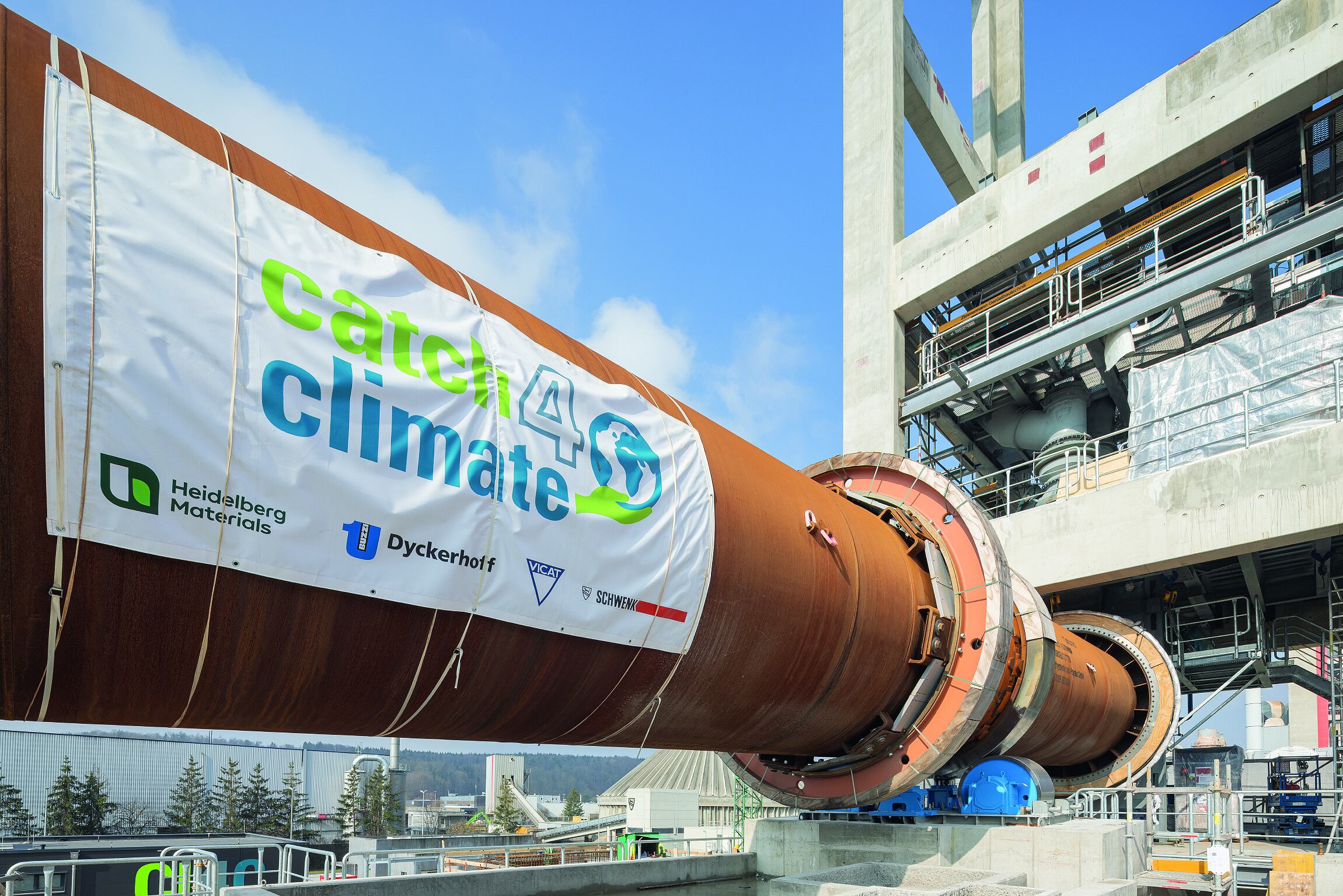
Image 1: The preheater tower was constructed using a hybrid method consisting of concrete columns produced using slip formwork and pre-assembled steel platforms.
Image 2: The rotary kiln was placed using a 700-tonne crane in a single lift.
Image 3: The four cement manufacturers Buzzi – Dyckerhoff, Heidelberg Materials, SCHWENK Zement and Vicat joined forces in 2019 to form a research company with the aim of realising the CO2 capture project “catch4climate”.
Image 4: For the research project “catch4climate”, the pure oxyfuel process for CO2 capture is being used for the first time. A dedicated rotary kiln line is being built for this purpose, serving exclusively for research and development.
© Armin Buhl
Info box
The Pure Oxyfuel Process
The pure oxyfuel process used in Mergelstetten (from oxy for oxygen and fuel) is a clinker firing process in which pure oxygen, rather than air, is introduced into the kiln in order to ensure heat generation through the combustion of primary and alternative fuels while excluding atmospheric nitrogen. In this way, the proportion of CO2 in the flue gas is increased to approximately 90 percent, thereby significantly expanding the CO2 capture potential. The aim is to capture 100 percent of the CO2 emissions of a cement plant in a cost-efficient manner. The project is also intended to create the conditions for the large-scale deployment of CO2 capture technologies in the cement industry. The capture enables subsequent utilisation or storage of the CO2 (CCU, CCS). In many industrial sectors – such as the production of fertilisers, fuels for long-haul flights or plastic-based hygienic medical products – carbon is urgently needed. Until now, this carbon has been obtained almost exclusively from fossil fuels. A further option is offered by the capture and utilisation of the CO2 produced in the cement industry.