 Menu
Menu


AT SCHWENK
Max Wild is building a new soil washing plant for mineral construction waste together with SCHWENK. This reflects a stronger commitment to research and development.
Offensive in construction material recycling
Press release dated 18 June 2024
Double expertise, double plant capacity and double recycling power: Max Wild GmbH, headquartered in Berkheim, is joining forces with SCHWENK Zement from Ulm to build a new soil washing plant in Baden-Württemberg. The wet mechanical processing plant will be built in the Biberach/Achstetten district and can process up to 250,000 tonnes of mineral construction waste into high-quality recycled building materials per year in shift operation. For Max Wild, this will be its second soil washing plant within four years. Together with the existing soil washing plant at Max Wild’s disposal centre in Eichenberg (Berkheim), the plant capacity and thus the recycling capacity in the region will double to up to 500,000 tonnes per year. Both companies are thereby sending a clear signal in favour of processing mineral construction waste and responsible circular economy and resource conservation – not only in Swabia and the Allgäu, but throughout the entire construction industry.
Subject to antitrust approval, SCHWENK and Max Wild will pool the expertise of both companies in the newly established entity SW BAUMINERALIK Donau Iller GmbH & Co. KG. The shareholders, represented by Markus Wild and Joachim Kainz from SCHWENK, are pleased about the regional partnership and the consistent further step towards resource efficiency.
Since 2020, Max Wild has been operating a soil washing plant at its own disposal centre in Eichenberg (Berkheim), making it one of the pioneers in construction material recycling. “We were one of the first German construction companies to bet on large-scale construction material recycling,” emphasises Markus Wild.
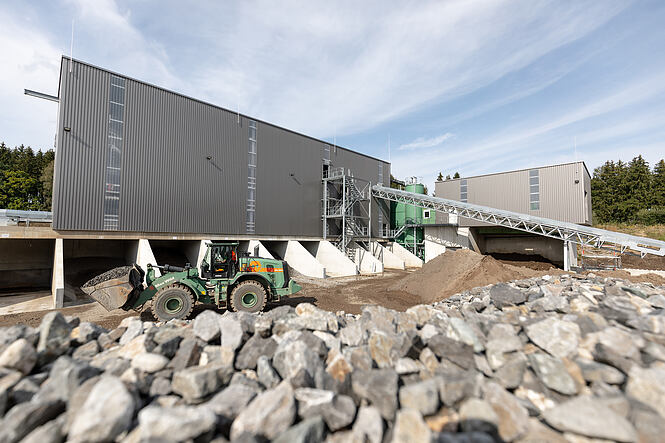
In operation since 2020: Max Wild’s soil washing plant recycles mineral construction waste and processes it into certified secondary building materials. Photo: Max Wild
Since the commissioning of the plant in Eichenberg, the professionals without boundaries have so far “washed” 500,000 tonnes of mineral construction waste. The sand and gravel fractions recovered during the cleaning process are returned by Max Wild to the economic cycle as equivalent secondary building materials. The secondary building materials are used in concrete plants, basement walls, floor slabs and in the asphalt industry.
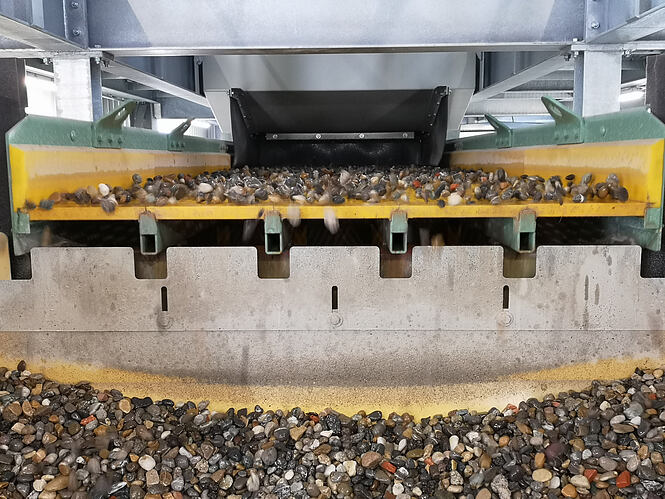
A look inside the soil washing plant: Max Wild’s wet mechanical processing plant cleans ballast and lightly contaminated excavated soil. Photo: Max Wild
„At SCHWENK we see the processing of mineral building materials as an essential component of the circular economy. Through the high-quality processing of the materials, valuable raw materials can be conserved while simultaneously producing high-performance products,” explains Joachim Kainz, responsible for the Circular Economy & Recycling division at SCHWENK.
The construction of the new soil washing plant is planned between Ulm and Biberach from August 2024 until the end of 2025. With the new soil washing plant to be built, the goal is to further increase the regional recycling rate and thus consistently expand the production of resource-efficient building materials. The modern processing plant will process excavated soil and track ballast into high-quality secondary materials such as aggregates, sands and chippings.